On this blog

Friday, May 4, 2012

Smorgasbord - Mourningtide

What to do?  What to do?

I have about 75,000 words written.  If you do the math, with one printed page comprised of 275 words, this story is currently at about 272 pages.  Respectable, though I tend to run just over 110,000 - 120,000 words.

I have things to fill in, transitions between scenes, chapters to write...

I have two specific chapters I want to write  The first ones involve the disappearance of the main character, who is mourning the death of his son  He is a very intelligent man, but also very direct.  He has a sense of humor, and the way he gives his loyal supporters the slip would be very amusing.

But then I also must write a chapter involving the woman  he falls in love with.  How does he handle his leaving and the revelation that he is definitely not what they had expected?

And, finally,the leave taking scene itself.

All of them have wonderful scope for writing, and I'll enjoy them all.  But - which to start first?

Ay, there's the rub.

I haven't written a thing tonight.

Tuesday, May 1, 2012

Just...happy.

It's the first of May.  The first day of a new month.

I was checking various things online, and I happened to see that someone bought a paperback copy of one of my books and another person bought it in ebook form.

I found myself smiling.  Yes, it's nice to sell things, but what makes writing so enjoyable for me - what keeps me writing - is the fact that someone, somewhere, is reading what I wrote and (I hope) enjoying it.  The fact that someone thought a story of mine, that I 'made up out of my own head', was interesting enough to spend money on it, make place on their shelf for it, is really warming.

Jackson Browne has a song, Roadies, that expresses it (for me):

but when that last guitar's been packed away,
you know that I still want to play.
So just make sure you got it all set to go
before you come for my piano

But the band's on the bus,
and they're waiting to go.
We gotta drive all night
And do the show in Chicago... or Detroit.
I don't know, we do so many shows in a row.
And these towns all look the same.
we just pass the time in the hotel rooms
and wander around backstage.
Till those lights come up, and we hear that crowd,
and we remember why we came.

People stay just a little bit longer
We want to play -- just a little bit longer
Now the promoter don't mind
And the union don't mind
If we take a little time
And we leave it all behind and sing
One more song
Oh won’t you stay just a little bit longer
Please, please, please say you will

Say you will


...I hope those folks enjoy their books/kindles. I wrote it for them.

Sunday, April 29, 2012

For Decency's Sake

I was in Gettysburg, once, at an antique shop. I'd been visiting the battlefield and now was enjoying some light shopping.  The owner asked me what I was looking for, and I told him "I'm trying to find an Ames light cavalry saber, 1863 model." That is my standard comment when I'm approached.  Of course he didn't have one (they aren't easy to find), but he said, "I can sell you a soldier..."

He had a box of bones. Someone, digging in his garden where there had been fighting in 1863, had discovered a burial. He dug the bones and accouterments up, put them in a box, and decided to try to sell them. I heard this, stared, and walked out. I wish I'd notified the Veteran's Administration. Everyone I've mentioned this to has been shocked that a body of a soldier should be so abused. Frankly, in my opinion, any body should be respectfully treated.

I am working on a story based on this experience,  In the story, the heroine buys the bones and contacts the Veteran's Administration.  The story follows her quest to discover who they belonged to, and what happened to him (other than being killed at Gettysburg).  It's a few years away from being finished, since I put it on the back burner,

I think  it's safe to say that anyone reading this blog knows that I am currently (and have been) writing some novels set in dynastic Egypt.  Late eighteenth to early nineteenth, to be precise.

Advances in imaging, medicine and DNA research have made it possible for us to learn a lot about the people of the Nile.  We are developing more information on that culture, and it is a good thing

However, we continue to do one thing that I find outrageous:

We put the corpses of their dead on exhibit.

If you read a book, say, on Tutankhamun, it will most likely contain photographs of his great-grandparents, Thuya and Yuya. It may also have a photo of his grandmother, the great queen Tiye. And it will almost certainly have a full face photograph of him.

So, what's wrong with that? Well, the fact that they are photographs of the mummies of those people. Bodies that were discovered and are now on display.

When the body of Ramesses II was taken to Paris to have some work done on it to stop its deterioration, it was accorded a twenty-one gun salute.  That is appropriate: he had been a head of state.  But if you go to the Egyptian Museum in Cairo, you can gape at a room of mummies.  A search for images will bring up photos of them.

I wonder what people would say if a history of the English monarchy for the past two hundred years contained within it photographs of the exhumed bodies of the royal family. Or perhaps a history of the American Civil War could have photographs of the bodies of Abraham Lincoln, Jefferson Davis, the various great generals of that time and, let's say, Clara Barton and Belle Boyd.

It sounds a little odd, doesn't it? Well, that's the problem I have with the display (all over the place) of mummies.

To me, this is just plain wrong.  Royal or not, these were human beings, not freaks, and putting them on display in this fashion is bad form. 

The Hyphen is Mighty Indeed

I just threw out five brand new copies of one of my books that I had ordered for a GoodReads giveaway.   They were free, a  perk for finishing NaNoWriMo.

I  had updated the book's cover.  When you do that, you have to resubmit the text.  And there was the rub:  there had been a problem with the text: my laptop had been stolen, and with it my final version of that manuscript.  (Yeah, I know.  I'm backing everything up now.)

It's easy to retrieve the text of a Kindle book, and I retrieved the MS that way, plugged it into the book setup, did a perfunctory final text check - the text had been fine before, and I had simply updated the cover image - and gave the go-ahead.  Then I ordered my five copies for the giveaway.

I'm beta testing a new feature for manuscript editing on CreateSpace.  It's a good feature, and since I had this book up in the  program, I went through that manuscript.   I sat back and went to one of my favorite scenes, one toward the end where Ramesses the Great, having extricated himself from arrest ordered by his eldest son, arrives at the palace to get some answers, is denied admittance by an over-zealous servant who isn't aware who's waiting outside the door, pulls out all the stops and, in the scene, is questioning the servant, a man he's known for fifteen years.  The scene is related from the servant's point of view:

"Let me see if I understand you," Pharaoh said thoughtfully. He raised one long fingered hand and ticked off the points as he spoke. "One  the Crown Prince has gone haring off to parts unknown. Two  you have no idea where Prince Khaemwaset is, but  three  you do know that he tried to drug his brother, and  four  a spy sent the Crown Prince's ring back to him as a sign of urgent danger to Prince Khaemwaset. Five  the army is in a state of alert, and  six  the city of Memphis is virtually under siege. Am I correct so far?"


It took me a moment to realize what was wrong with the text. Actually, it doesn't look so bad, even now, but I'd placed hyphens in to highlight the way Ramesses was ticking off the points on his fingers. And the hyphen between 'long' and 'fingered' described the sort of fingers he had on his hand. Without it, His Majesty had a long hand equipped with fingers.


It should have looked like this:

"Let me see if I understand you," Pharaoh said thoughtfully. He raised one long-fingered hand and ticked off the points as he spoke. "One-the Crown Prince has gone haring off to parts unknown. Two-you have no idea where Prince Khaemwaset is, but-three-you do know that he tried to drug his brother, and-four-a spy sent the Crown Prince's ring back to him as a sign of urgent danger to Prince Khaemwaset. Five-the army is in a state of alert, and-six-the city of Memphis is virtually under siege. Am I correct so far?"

In looking things over I discovered, to my dismay, that the file transfer from Kindle to print had stripped every hyphen from the text.  And I hadn't caught them.

I started looking for them.  I went to another scene where the servant, newly captured after a battle between Egyptians and Hittites (his country), gives everyone a piece of his mind using a coarse expression that draws a parallel between their sexual propensities and Oedipus'.  (I am not going to quote it here; it's about an eighth of the way through Chapter XIX; the bottom of page 121 if you have a paperback copy of the book.)

In my defense, the text had been perfect when I sent it to Kindle; the manuscript in my (stolen) laptop had been lost, I had retrieved it (I thought...) and simply plugged it in.  But my father always told me never to make assumptions.

Ultimately, I pulled up the adobe document for the manuscript and manually searched it for hyphens.  When I found one, I went to the manuscript and replaced it.  I was able to do global searches for set expressions, but when I relied solely on that method, checking afterward, I kept stumbling across hyphens that needed to be inserted.  (To be honest, I would never have found Mutallish' epithet directed at Pharaoh if I'd done a global search and replace for commonly used hyphenated words.)

Things were fixed.  Finally.  It was too late to cancel my order of the printed books.  So what to do about them?

Well, they're defective.  I've read enough diatribes on the subject of defective books, whether self-published or not.  These are all, every one of them, being consigned to the trash.  Sigh.

Lesson Learned.


Friday, April 27, 2012

Seannachie, Seannachie, Spin Me a Yarn...


A story, once told, has as much reality as a piece of embroidery or a painting. Myths, bearing within them the very essence of eternal truths, make up the core of our existence. The fabric of legend surrounds us every day like coats of many colors that we can no longer see or feel for their very familiarity. We move through landscapes of myth with the heedless nonchalance of treasure-house guards accustomed to treading upon a rainbow of precious stones in the course of their daily work. And yet the beauty and the color are there to be seen by any who are willing to look and see. A good storyteller is one who can somehow touch these myths and bring them to renewed life in his tale. (from the afterword to The City of Refuge)


I remember a Career Day at my high school years ago, when a writer was engaged to speak to a classroom full of kids. She told of what it was like to be a writer, specifically a novelist. I sat there and listened to her, and I was too shy to say that I was writing stories (I was, too; I had written two in longhand, one of them rather thick). She fussed over a more forward student who admitted to being a writer.

She started out by asking whether any of us had the old Irish name 'Shaughnessy'. None of us did. She then told how it arose from the Gaelic 'Seannachie', or 'storyteller'. I thought it was interesting, and there and then made up a pen name for myself. I may yet use it.

A seannachie was somewhat more than a 'storyteller'. According to Webster, the definition is:


Sean´na`chie
A bard among the Highlanders of Scotland, who preserved and repeated the traditions of the tribes; also, a genealogist

Most cultures had them.  The story of the siege of Troy was passed down verbally from generation to generation before it was written down.  To a degree, those of us who listen to the stories our parents and grandparents tell and either write them down ourselves or bully them into doing it, are fulfilling the same function.

I remember reading a woman's account of her mother teaching her some songs and saying 'You'll need this some day', as though the songs would help her to cope with whatever life deals out.  She said that it had.

I can attest to that.  I was listening to The Mary Ellen Carter, a song written by Stan Rogers about the wreck of a ship.  It had been recorded by an Irish group of pub singers (and darned good they were, too!), and I was enjoying the tale of the ship, how she was wrecked, and how the remnants of her crew determined to bring her back ('make the Mary Ellen Carter rise again').

And then I heard the last verse:


...And the laughing, drunken rats who left her to a sorry grave
They won't be laughing in another day. . .
 
And you, to whom adversity has dealt the final blow
With smiling bastards lying to you everywhere you go
Turn to, and put out all your strength of arm and heart and brain
And like the Mary Ellen Carter, rise again.

Rise again, rise again - though your heart it be broken
And life about to end
No matter what you've lost, be it a home, a love, a friend.
Like the Mary Ellen Carter, rise again.

I sat up, breathless.  I'd dealt with those 'smiling bastards lying to you everywhere you go'.  I had!  It was like remembering a time when I had thought myself alone and abandoned and discovering that I'd had friends and sympathizers beside me, that I hadn't known of.  And this from a song I heard on a CD.

How many of us read a novel and get something from it aside from a moment's entertainment?  I know I do.  (Heck, I've taken away some pretty profound lessons from Disney's cartoon The Emperor's New Groove - watch it and you may see what I mean!)

We write our books (most of us) to entertain people. I am still blown away when I see that someone shelled out cash to read something I 'made up out of my own head', but maybe that's just my oddness.  Our creativity is fueled by everything around us - whether stories our grandparents told us or myths we have heard or things we have read.  When I talk to people about what they have read, that I have written, and what they have gained from reading it, I am left feeling a little breathless.

Perhaps I, too, am a seannachie.

Sunday, April 22, 2012

New Covers

I am involved in graphic design and web maintenance (on a small scale) and I have designed my own covers. This is not to say that others couldn't do better than me. I know better. But for now...


I've been overhauling my book cover, and this day I worked on the cover for The City of Refuge.  I've wanted to redo it for some time.

The story takes place in Akhenaten's capitol city of Akhet-Aten (better known as Amarna).  It occurs twenty-five years aftr it was abandoned.  Although Akhenaten is long dead by the time of the story, his presence is definitely felt.

I had origially designed a cover using the bust of Nefertiti, but the redo has her husband Ahenaten's statue on it.  He is a presence in the story (remembered by characters).  It seems more fitting.

I'd be curious about others' thoughts:


Older cover


Saturday, April 21, 2012

Adventures in Photoshopping - Or Why it is Important to have Good Photos

I do some graphic design in a small way, and I manage a couple websites.  Recently I was asked by one client to find a photo of a cat she owned and send it off to another person to be used  in an award that this cat won,

While the person in question is intelligent, charming and very good indeed, she and her equally delightful husband are firmly settled in the era of wax tablets and sealing wax.

They don't understand the need for good photos and the ways to preserve them.

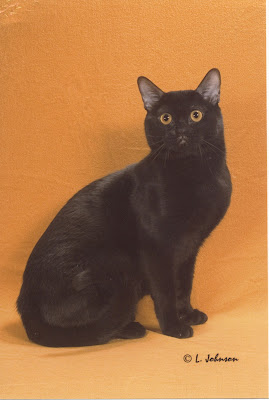
I asked them if they had a photo of the cat in question - a fellow named 'Anzo', which means 'Young God'.

Anzo hails from Paris, and for the first couple years he lived in the United States he understood only French.  At one point his owner was trying to coax him from his bed at a Cat Show.  He just blinked at her.

I came over.  "Anzo!" I said.  "Leve-toi paresseux!   Allez, allez!" (Anzo - get up, lazybones!  Come on!)  He widened his eyes at me and strolled over.
Six years later he is retired and getting an award. 

One photo was tiny.  I couldn't make it any 'bigger' or clearer.  So I located another, scanned by his owners in antediluvian times:

Poor color, faded...  I cringed.  And I decided to try to retrieve it.  Anzo was gleaming black with bright copper eyes and a level look.  I didn't think it would be terribly hard to bring him back.  So I set to work.

Photoshop has tools that enable you to cut blur, restore brightness and contrast, and cut 'noise' from a photo.  If you know what you are doing, you can restore the 'freshness' of a photo.  This has nothing to do with falsifying things (which, unfortunately, some people do), and everything to do with making repairs.  Here's handsome Anzo, the charming fellow from Paris, in all his original glory.


I'll have to post some other endeavors, but that will be another time.